
Why every escape room needs a signed waiver

A signed waiver is the single most practical legal document an escape room operator can hold. It records that each participant understood the risks before walking through the door, and it defines the boundaries of your liability if something goes wrong. Without one, a single injury claim can threaten the financial viability of your venue, particularly for small, independent operators.
Escape rooms carry genuine physical and psychological risks that justify a formal agreement:
- Confined spaces and low-light environments that can trigger anxiety or claustrophobia
- Physical puzzles requiring climbing, crouching, or lifting
- Psychological pressure from time limits and immersive scenarios
- Props and set elements that participants may interact with unexpectedly
Under Australian law, a waiver helps define the liability boundary between operator and participant by securing informed consent before the activity begins. That said, a waiver is not a blanket shield. It does not remove all legal exposure, and the wording must be precise to hold up when tested.
Key legal components of escape room waivers in Australia
Australian waivers must cover specific ground to be enforceable. A document that is too vague, too broad, or poorly worded gives opposing counsel room to move. The core clauses every escape room waiver should include are:
- Risk acknowledgment: A plain-language statement that the participant understands the physical and psychological demands of the activity
- Voluntary assumption of risk: Confirmation that participation is the participant’s own choice, made with full awareness of potential hazards
- Indemnity clause: The participant agrees not to hold the operator liable for injuries arising from the acknowledged risks
- Limitation of liability: Caps or excludes the operator’s financial exposure for covered incidents
- Physical activity and confined space acknowledgment: Specific reference to the nature of escape room environments, including confined space risks and physical exertion requirements
- Participant responsibility statement: Confirmation that the participant takes responsibility for their own safety and will follow staff instructions
One hard limit applies regardless of how well the document is drafted. Australian law does not permit operators to exclude liability for intentional or grossly negligent acts, injury to life or health, or breaches of essential contractual obligations. A waiver that attempts to do so will not hold. This is why insurance remains a necessary complement to any waiver, not a replacement for it.
Ambiguous wording is the most common pitfall. If a clause can be read two ways, a court will read it against the operator. Keep language specific to activities that actually occur at your venue, and avoid sweeping exclusions that have no connection to your rooms.
What a practical waiver template looks like
A workable escape room waiver template for Australian venues covers the following sections in order:
| Section | Purpose |
|---|---|
| Participant details | Full name, date of birth, contact information |
| Activity description | Brief description of the escape room experience and its physical/psychological demands |
| Risk acknowledgment | Participant confirms awareness of confinement, physical activity, and psychological elements |
| Voluntary participation | Participant confirms they are choosing to participate freely |
| Indemnity and liability release | Participant releases the operator from claims arising from acknowledged risks |
| Health declaration | Participant confirms they are in good health and not impaired |
| Minor consent | Parent or guardian signature for participants under 18 |
| Participant signature and date | Binding agreement |
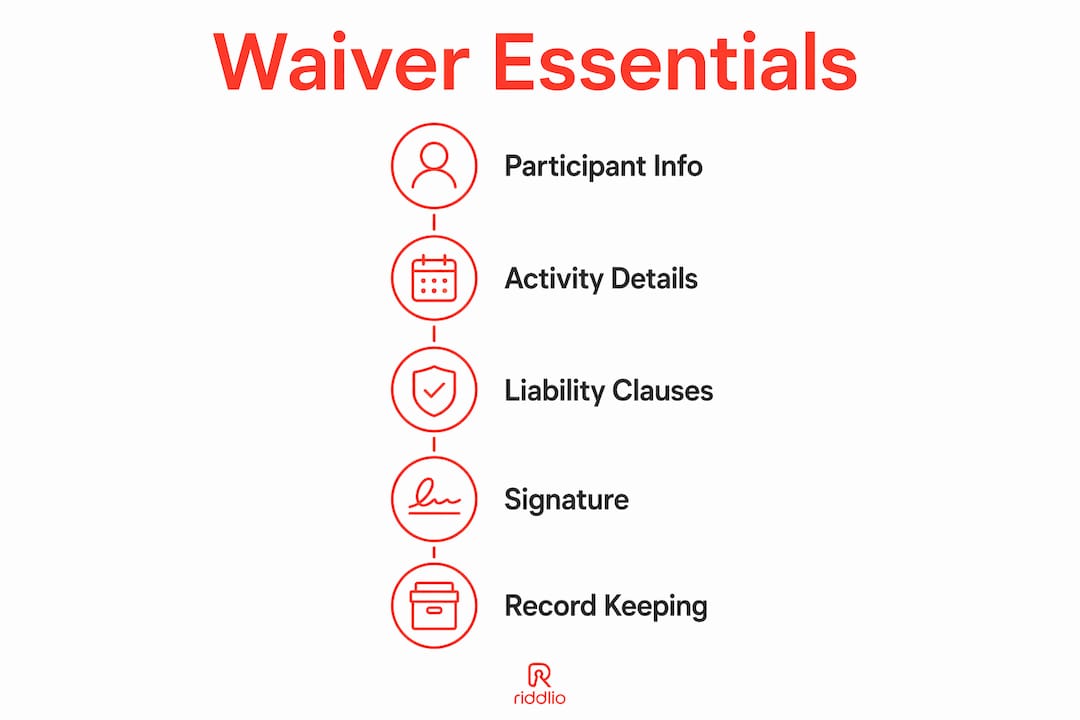
Who signs and when. Every participant aged 16 and over should sign individually. For participants under 18, a parent or guardian must sign on their behalf. The best time to collect signatures is before arrival, integrated into your booking confirmation workflow. Collecting waivers at the door eats into game time and creates pressure that can lead to rushed, uninformed consent.
Record keeping. Store signed waivers securely with easy retrieval capability. If a dispute arises months after an incident, you need to locate that specific participant’s signed document quickly. Digital storage with search by name or booking date is far more reliable than a folder of paper forms.
Pro Tip: Have a solicitor review your waiver before you use it. Template language is a starting point, not a finished product. A professional legal review catches ambiguous clauses and adapts the document to your specific venue risks, which is the only way to know it will hold up.
For corporate group bookings, where liability questions are more complex, it is worth reviewing how team building escape room operators structure their group consent processes. Each individual participant still needs their own signed waiver, even when one person organises the booking.
How digital waivers improve operations at your venue
Paper waivers create a bottleneck at check-in that costs you game time and frustrates participants. Digital waivers solve this by allowing participants to sign before they arrive, so they walk in ready to be briefed on the room rather than on paperwork.
The operational gains are concrete:
- Pre-arrival signing: Participants complete the waiver at home on any device, eliminating queue time at the door
- Group management: One booking link lets every member of a group sign individually and simultaneously, a group can be done in minutes
- QR code access: A QR code at your reception desk handles walk-ins and late signers without staff intervention
- Instant verification: Staff can confirm all group members have signed with a single search by name or booking reference
- Secure cloud storage: Signed documents are stored with timestamps and are retrievable for as long as you need them for legal compliance
Pro Tip: Include the waiver signing link directly in your booking confirmation email. Most participants will sign within hours of booking, which means your check-in process becomes a greeting rather than an admin task.
Digital waiver platforms that integrate with booking systems like Bookeo automate the collection and grouping of waivers by reservation, removing the need for manual matching. Custom branding keeps the experience consistent with your venue’s identity rather than presenting participants with a generic third-party form. For venues running multiple rooms or franchise locations, scalable plans accommodate higher monthly waiver volumes without per-document fees.

The shift to digital is not just about convenience. A well-run digital waiver process signals professionalism to participants before they even arrive, and it gives you a defensible, timestamped record if a claim ever surfaces.
Riddlio handles waivers as part of your full booking workflow
Running a tight escape room schedule means every minute between groups counts. Chasing unsigned waivers at the door is a problem that should not exist in 2026.

Riddlio’s escape room management software includes built-in digital waiver collection as part of its booking workflow. Participants receive the waiver link in their booking confirmation automatically, sign on any device before arrival, and your team sees verified signatures in the same dashboard used to manage bookings, payments, and scheduling. No separate waiver platform to log into, no manual matching of forms to reservations.
For operators who want everything in one place, Riddlio’s online booking calendar connects waiver collection, SMS reminders, and payment processing into a single system built specifically for escape room venues. See how it fits your operation at riddlio.com.
Key takeaways
A signed, legally reviewed waiver is the foundation of liability protection for any Australian escape room, and digital collection before arrival is the only practical way to manage it at scale.
| Point | Details |
|---|---|
| Waivers define liability limits | A signed waiver records informed consent and sets the boundary of operator liability under Australian law. |
| Legal limits still apply | Waivers cannot exclude liability for gross negligence, intentional harm, or breaches of core contractual duties. |
| Template is a starting point | Every waiver should be reviewed by a solicitor and adapted to your specific venue risks before use. |
| Digital collection saves game time | Pre-arrival signing via booking confirmation eliminates check-in bottlenecks and protects briefing time. |
| Riddlio integrates waivers with bookings | Riddlio connects digital waiver collection, reminders, and scheduling in one platform built for escape rooms. |