A price floor is the lowest price you will ever sell a ticket for, full stop, and a price floor strategy is the set of rules that keeps every discount, dynamic-pricing algorithm, and last-minute promo above that line. The single best move you can make today: set your floor at or above break-even per player, build three pricing bands (floor, base, ceiling), and lock any automated pricing tool inside those rails so it can never quote below cost.
From there, three guardrails do most of the heavy lifting:
- Hold the line for 48 hours. Never drop a publicly visible price within 48 hours of a session.
- Fill gaps privately. Use targeted promo codes for last-minute seats instead of public discounts.
- Review monthly. Check load factor and yield every month and adjust bands, not just individual prices.
Get those three right and you have a functioning price floor policy before you’ve even opened a spreadsheet.
Key Takeaways
A price floor strategy works when the floor is calculated from real per-session cost, bound into three pricing bands, and protected by a 48-hour rule that keeps discounting private rather than public.
| Point | Details |
|---|---|
| Set the floor above break-even | Calculate per-head cost including staff, consumables, overhead, and payment fees, then add a 15 to 20% margin buffer. |
| Use three pricing bands | Map every calendar slot as floor, base, or ceiling before applying any dynamic or scheduled pricing. |
| Hold the 48-hour rule | Never drop a public price within 48 hours of a session; fill gaps with private, time-boxed promo codes instead. |
| Test changes over at least four weeks | Track load factor, yield per slot, secondary spend, and review sentiment before locking in a new floor. |
| Automate bands with Riddlio | Riddlio lets operators set floor, base, and ceiling bands with scheduled tiers and private promo codes on a flat monthly plan. |
Table of Contents
- Why price floors matter for escape room venues
- How do you calculate a practical price floor?
- How price floors work with dynamic pricing
- Rolling out price floors without breaking trust
- What metrics tell you a floor change is working?
- Adjusting price floors for seasons and demand shifts
- Common pitfalls when implementing a price floor
- Case studies from the escape room industry
- Legal and ethical considerations around setting price floors
- What actually determines whether a floor strategy works
- Automate your floors and guardrails with Riddlio
- Sources
Why price floors matter for escape room venues
A price floor exists to stop you selling a $45 ticket for $22 on a slow Tuesday just to fill a room. That sale might cover the game master’s wage for the hour, but it eats into the contribution margin you need to cover rent, marketing, and software subscriptions. Once you’ve calculated what a session actually costs to run, a floor simply refuses to let a booking clear below that number.
The second job a floor does is protect perceived value. Escape rooms sell an experience, not a commodity, and experiences that get marked down constantly start to feel cheap regardless of production quality. Academic research on ticket pricing in sports venues found that floors and ceilings function as revenue-management mechanisms that limit damaging price volatility and protect regular buyers from feeling like they overpaid compared to someone who booked a day later at half price. The same dynamic plays out in a 90-minute puzzle room as it does in a stadium seat.
There’s a reputational cost to visible discounting too. Customers who see a public price drop today will wait for the next one, and your Tuesday-night regulars start booking Thursday instead. A floor removes that incentive because there’s simply no lower price to wait for.
How do you calculate a practical price floor?
Work out your break-even per head first, then add a margin buffer on top. That buffer, not the raw break-even number, is your actual floor.
Start by listing every cost tied directly to running one session:
- Staff allocation — the game master’s hourly rate divided across the slot length.
- Consumables — props, ink, cleaning supplies, replacement parts.
- Cleaning and turnover — time and materials between groups.
- Incremental overhead — a per-slot share of utilities, software, and insurance.
- Payment processing fees — the percentage your processor takes off each booking.
The formula is straightforward: (allocated slot cost + variable cost per booking) divided by your expected average party size, then add a minimum contribution margin buffer on top depending on how much profit you need to achieve per session.
Here’s a worked example for a six-player room:
If your base ticket price is $19 per person, that $12.60 floor sits at roughly 66% of base, right in line with the 60 to 70% guidance many attraction operators use when mapping their three bands.
Pro Tip: Recalculate your floor whenever a fixed cost changes, not once a year. A rent increase or a new payment processor fee can quietly push your floor above prices you’re still advertising.
Corporate bookings and private hires need a different floor because your variable cost per head usually shrinks with group size, and you’re often selling the whole room rather than per-seat tickets. Build a separate floor for private hires using the same formula but with your actual minimum group size, not the theoretical maximum.
How price floors work with dynamic pricing
Floors and dynamic pricing aren’t in tension. The floor is the guardrail; the dynamic engine is what moves within it. Structure your calendar with three bands: floor for genuinely dead slots, base for standard demand, and ceiling for weekend prime time or holiday periods where willingness to pay is highest.
For most independent venues, “dynamic-lite” beats full algorithmic pricing. Dynamic-lite means scheduled tiers you set and trigger manually, peak Friday nights at ceiling, quiet Tuesday afternoons at floor, rather than software that recalculates prices in real time. Event-pricing research suggests dynamic-lite approaches capture nearly all the financial upside of full dynamic pricing without the customer backlash that comes from prices visibly changing hour to hour.
If you do run an algorithmic tool, it needs hard limits, not suggestions:
- An absolute price floor the algorithm cannot cross.
- A ceiling cap for peak demand.
- A maximum step size, so no single price change is jarring enough to look like a glitch.
- A private channel for last-minute discount codes, kept separate from your public listings.
Bounded dynamic pricing works because the operator decides where the rails sit before the algorithm ever runs. The system optimises inside a range you’ve already judged to be safe, it doesn’t decide the range itself.
That’s the same principle behind guidance for AI-driven pricing in the tours and activities space, and it’s exactly how Riddlio’s dynamic-pricing tools handle peak, off-peak, and group pricing for escape rooms: you set the bands, the platform manages the calendar inside them.
Rolling out price floors without breaking trust
Launching a floor strategy badly does more damage than not having one at all, so sequence it properly.
- Map your calendar first. Before touching a single price, colour-code every slot for the next four weeks as ceiling, base, or floor based on historical booking data.
- Apply the 48-hour stable rule. Once a price is published for a session within 48 hours of its start time, it doesn’t move publicly. If you need to fill it, use a private promo code instead.
- Set a change-control process. One person authorises price changes, every change gets logged with a reason, and you review the whole calendar monthly, not slot by slot.
- Rewrite your marketing copy. Phrases like “from $19” or “off-peak sessions available” let you advertise your floor honestly without training customers to expect discounts on demand.
The 48-hour rule matters more than it looks. Operators who’ve tested it consistently find that public last-minute drops train regular customers to delay booking, waiting for the discount, which drags down your average yield across the board. A private code sent to your email list or a local partner achieves the same fill without that side effect.
Pro Tip: Keep your private promo codes single-use and time-boxed to 24 hours. A code that lingers on a coupon site defeats the entire purpose of keeping it private.
What metrics tell you a floor change is working?
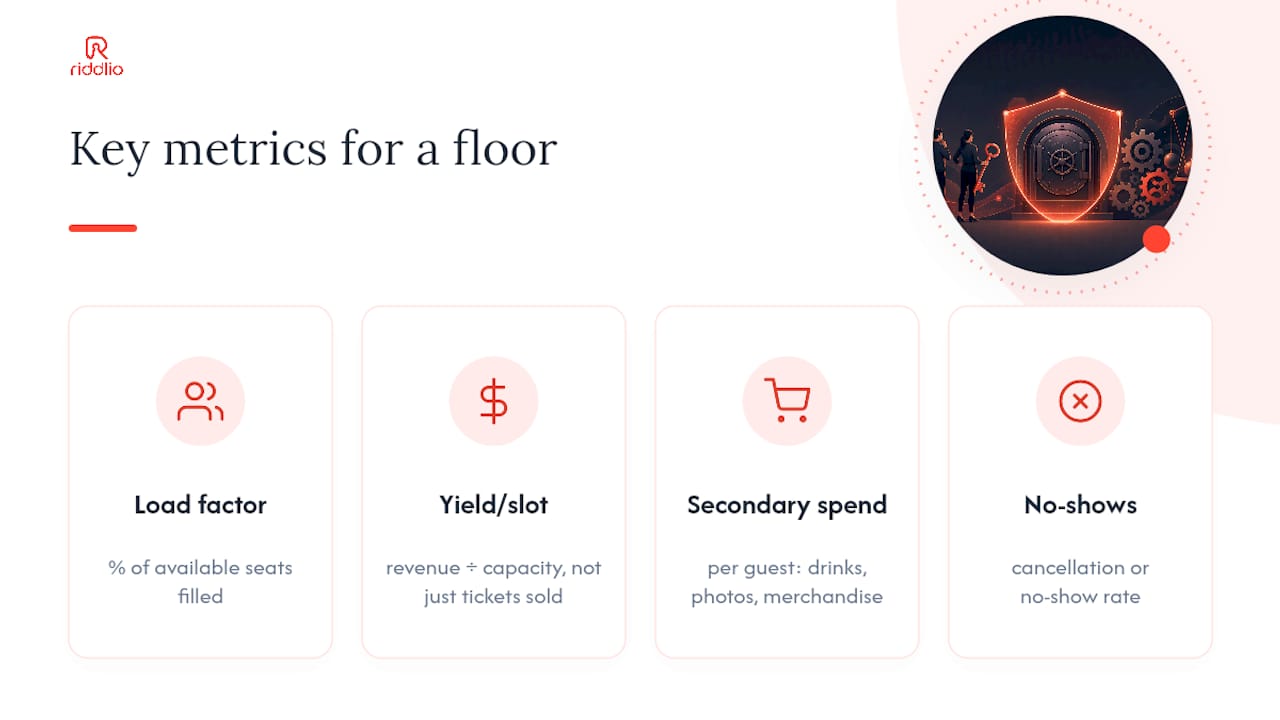
Four numbers matter more than the rest: load factor (the percentage of available seats filled), yield per slot (revenue divided by capacity, not just tickets sold), secondary spend per guest, and your cancellation or no-show rate. Review sentiment matters too, since a floor that protects margin but tanks your Google rating has just traded one problem for another.
Run any floor change as a proper test, not a gut call. Give it four to eight weeks minimum, since a single quiet week can look like a trend when it’s just weather or a local event. Segment by session type and day of week rather than looking at one blended average, because a floor that works brilliantly on weekends can be quietly losing you off-peak bookings you used to win with modest discounting.
Interestingly, operators often find that filling an off-peak slot at a discount still lifts total venue revenue because secondary spend, drinks, retake photos, merchandise, stays close to normal per head even when the ticket price is lower.
Build a simple dashboard that flags load factor drops and review-score dips weekly rather than waiting for the monthly report to surface a problem that’s already cost you three weeks of bookings.
Adjusting price floors for seasons and demand shifts
Your floor shouldn’t be a single number set once a year. Costs shift with utility rates and staff wages, and demand shifts with school holidays, local events, and weather. A floor calculated in January using off-peak utility costs can undersell you badly by August if your air-conditioning bill has doubled.

Revisit your floor calculation quarterly at minimum, and treat any month with a major cost change, a wage increase, a new lease term, a processor fee hike, as an automatic trigger to recheck the number. The floor itself rarely needs to move often, but the base and ceiling bands around it should flex with demand far more frequently.
Seasonal high-demand periods, school holidays, Halloween, corporate end-of-year events, are where your ceiling band earns its keep. Push ceiling pricing hard during genuine peak windows, but resist the temptation to also raise the floor during these periods purely because demand is high. The floor’s job is protecting you against a bad week, and a bad week can still happen the Tuesday after Halloween when demand craters back to normal.
Low-demand stretches, January, mid-winter weekdays, are exactly when the floor matters most because it stops well-meaning “let’s just get some bookings in” thinking from pricing sessions below what they cost to run. If a slot can’t clear your floor even with promotion, the better answer is often to close it and consolidate staff rather than sell it at a loss.
Common pitfalls when implementing a price floor
The most common mistake is setting the floor from gut feeling rather than an actual cost calculation. Owners who eyeball a “reasonable minimum” often land below their true break-even without realising it, because they forget to include payment processing fees or an accurate share of overhead.
The second mistake is treating the floor as fixed forever. Costs move, and a floor calculated two years ago is almost certainly stale, especially if staff wages or rent have increased since.
A third pitfall is inconsistent enforcement. If your floor policy allows exceptions “just this once” for a friend’s group booking or a slow news day, you’ve effectively deleted the floor. The rule only works if it applies without exception, including to bookings that feel like they should get a break.
Public discounting is the fourth trap. Advertising a flash sale on social media the same day it applies teaches your audience to wait for the next one, and undoes months of careful band management in a single post. Keep any below-base pricing inside private channels, targeted email lists, local partnerships, loyalty programs, rather than your public booking page.
Finally, watch for floor creep on group and corporate rates. It’s tempting to quote a large group a rate that looks generous on paper but actually sits under your true per-head cost once you factor in the extra staff needed to run back-to-back private sessions. Recalculate the floor for group bookings separately rather than applying your standard per-seat number.
Case studies from the escape room industry
Independent operators who’ve adopted structured banding report a consistent pattern: revenue improves not because prices go up everywhere, but because off-peak slots stop bleeding money while peak slots finally capture what customers are actually willing to pay. Industry guidance on variable and tiered pricing for attractions points to this same effect across the wider experience economy, tiered approaches that respect a floor tend to outperform flat, one-size pricing precisely because they stop the two most common revenue leaks: underpriced peak demand and loss-making off-peak fills.
The pattern that shows up again and again in operator discussions is the shift away from ad hoc discounting toward scheduled tiers. A venue that used to slash Tuesday prices whenever bookings looked thin, inconsistently, without tracking the impact, instead moves to a fixed Tuesday-base rate that sits comfortably above floor. The result isn’t always more Tuesday bookings, but it is more predictable Tuesday revenue, and staff stop guessing what today’s price should be.
Group and corporate bookings tell a similar story. Venues that build a separate floor for private hires, rather than discounting per-seat pricing down to match a large group’s budget, typically find corporate revenue per session actually rises, because the private-hire floor accounts for the extra staffing and exclusivity a corporate client is genuinely paying for.
Legal and ethical considerations around setting price floors
Setting your own minimum price for a service you own and sell directly is standard commercial practice and isn’t something you need special approval for. The legal complications tend to appear in secondary or resale markets, not in direct-to-consumer pricing like escape room bookings. Public backlash over concert-ticket floor pricing on the resale market shows what happens when floors are perceived as manipulating a marketplace rather than protecting a venue’s own margin, worth knowing even though escape rooms rarely face resale issues.
The ethical questions that do apply to escape rooms are about transparency rather than legality. Advertising “sessions from $19” when almost no session actually sells at $19 risks misleading customers, so keep your floor genuinely available at least occasionally, on the slots you’ve mapped as floor-tier, rather than using it purely as bait copy. Similarly, private promo codes should go to identifiable groups, your email list, local partners, past customers, rather than being dressed up as an exclusive offer while actually being available to anyone who searches for a coupon.
Consistency also matters ethically, not just operationally. If two customers book the same session type on the same day and pay meaningfully different prices because one got a private code and the other didn’t, be prepared to explain that difference honestly if asked. Most customers accept peak and off-peak pricing readily. What erodes trust is a sense that pricing is arbitrary or that regulars are being penalised for loyalty while new customers get better deals through discount codes.
What actually determines whether a floor strategy works
Most advice on pricing escape rooms treats the floor as a defensive number, the price you’re not allowed to go below, and stops there. That undersells what a floor actually does. A well-built floor is what makes dynamic pricing usable at all for a small operator, because it converts an intimidating “should I discount tonight?” decision into a rule you already made weeks ago.
The conventional advice oversells full algorithmic dynamic pricing for venues running a handful of rooms. Volume matters here. A theme park with hundreds of daily transactions has enough data for real-time algorithmic pricing to learn from. A six-room escape venue running maybe 15 to 20 sessions a day doesn’t generate that kind of signal, so dynamic-lite, scheduled tiers a human sets and reviews, will usually outperform a black-box algorithm for years before volume justifies the more complex approach.
What I’d prioritise first, ahead of any pricing sophistication, is getting the break-even calculation right and reviewing it quarterly. Everything else, bands, tiers, promo codes, is built on top of that number. Get it wrong and every clever pricing tactic you layer on top is just optimising around a mistake.
— Iosif Beraru
Automate your floors and guardrails with Riddlio
Riddlio gives escape room operators a way to enforce every rule covered here without a spreadsheet doing the policing. You set your floor, base, and ceiling bands once inside Riddlio’s dynamic-pricing tools, schedule your tiers for peak and off-peak windows, and issue private promo codes for last-minute fills, all from the same calendar your team already uses for bookings.

Because bookings, payments, and analytics live in one platform, you can track load factor and secondary spend the way this article recommends without stitching together three separate tools; for example, Animal Booking’s pricing illustrates how booking platforms structure costs that can affect your bottom line. Automated SMS reminders cut no-shows, which matters more once you’ve calculated a floor tied tightly to break-even, a no-show at floor price is a loss, not just a missed upsell. And because Riddlio runs on a flat monthly rate with no per-booking fees, testing a new band structure for a season doesn’t cost you more the busier you get.
If you’re ready to put real guardrails around your pricing, explore the online booking calendar and see how bands and scheduled tiers slot into a system built specifically for escape rooms.
Sources
- Dynamic Ticket Pricing for Attractions: Peak & Off-Peak (2026) | EquipDash
- Pricing practices of football and basketball clubs in Italy - PMC
- Dynamic Pricing for Events: When It Helps or Hurts | TickPick Organizer — TickPick