Bundle pricing means selling two or more products or services together at a single combined price, usually lower than buying each item separately. Done well, it lifts average order value (AOV), moves slow-moving inventory, and simplifies the buying decision all at once.
Use it when you want to:
- Lift AOV without running a sitewide discount
- Clear inventory by pairing slow sellers with popular ones
- Simplify choices and reduce decision fatigue at the point of purchase
When the bundle is designed around what the buyer actually needs rather than what you want to offload, businesses consistently see higher revenue per transaction and stronger customer retention. The US Department of Justice and pricing research bodies like Simon-Kucher & Partners both treat bundle design as a strategic discipline, not a promotional afterthought.
Key takeaways
Bundle pricing lifts average order value and improves conversion when the bundle is designed around a specific buyer need and priced above a clear contribution-margin floor.
| Point | Details |
|---|---|
| Design around buyer jobs | Bundles built around what the buyer needs outperform discounted collections every time. |
| Use the 10–25% discount range | Below 10% feels negligible; above 25% risks margin erosion and trains bargain behaviour. |
| Measure profit per order | AOV is a proxy metric; bundle gross margin is the number that actually matters. |
| Run a 30-day A/B test | Split traffic, tag bundle SKUs separately, and measure at 60 days before scaling. |
| Riddlio for experience venues | Riddlio tracks bundle attach rates, dynamic pricing, and voucher redemptions in one platform. |
Table of Contents
- What makes bundle pricing work for your business?
- Which bundle pricing strategy fits your situation?
- How do you set the right bundle price?
- Bundle pricing examples you can adapt today
- How to launch and A/B test a bundle offer
- What are the risks of bundle pricing?
- Applying bundle pricing to escape rooms: a practical walkthrough
- The part most guides get wrong about bundle pricing
- Riddlio makes bundle operations practical for experience venues
- Sources
What makes bundle pricing work for your business?
The commercial case for bundles is straightforward: one transaction, more revenue. But the psychology underneath is what makes them convert.
Price anchoring does a lot of the heavy lifting. When a customer sees three items priced at $30, $25, and $20 individually, then sees a bundle at $59, the $16 saving feels concrete. The original prices become the reference point, and the bundle price looks like a bargain even if the margin you gave up was modest.
The decoy effect matters too. A mid-tier bundle positioned between a bare-bones option and a premium one nudges buyers toward the middle, which is often your highest-margin offer. And choice reduction is underrated: buyers who face fewer decisions convert at higher rates. A well-named bundle (“Starter Kit”, “Team Night Out”) removes the cognitive load of assembling a purchase from scratch.
Measurable business outcomes to expect, and which metric they move:
- Higher AOV per transaction (directly)
- Improved conversion rate (fewer abandoned carts from decision fatigue)
- Better attach rate on accessories or add-ons
- Reduced inventory carrying costs when slow SKUs are bundled with fast movers
- Higher customer lifetime value when bundles drive repeat purchase behaviour
As Simon-Kucher’s research makes clear, a bundle that solves a specific buyer problem outperforms one that is simply a discounted collection. The framing matters as much as the price.
Bundles also improve ad efficiency. Because each order carries more gross profit, your break-even return on ad spend (ROAS) drops, meaning you can acquire customers profitably at a lower revenue threshold per click.
Which bundle pricing strategy fits your situation?
There are seven main bundle types. Choosing the wrong one for your margin profile or sales channel is one of the most common mistakes operators make.
According to Wikipedia’s product bundling taxonomy, the four foundational types are pure bundling, mixed bundling, leader bundling, and captive pricing. Three more have become standard in ecommerce and SaaS: tiered bundles, post-purchase bundles, and quantity bundles.
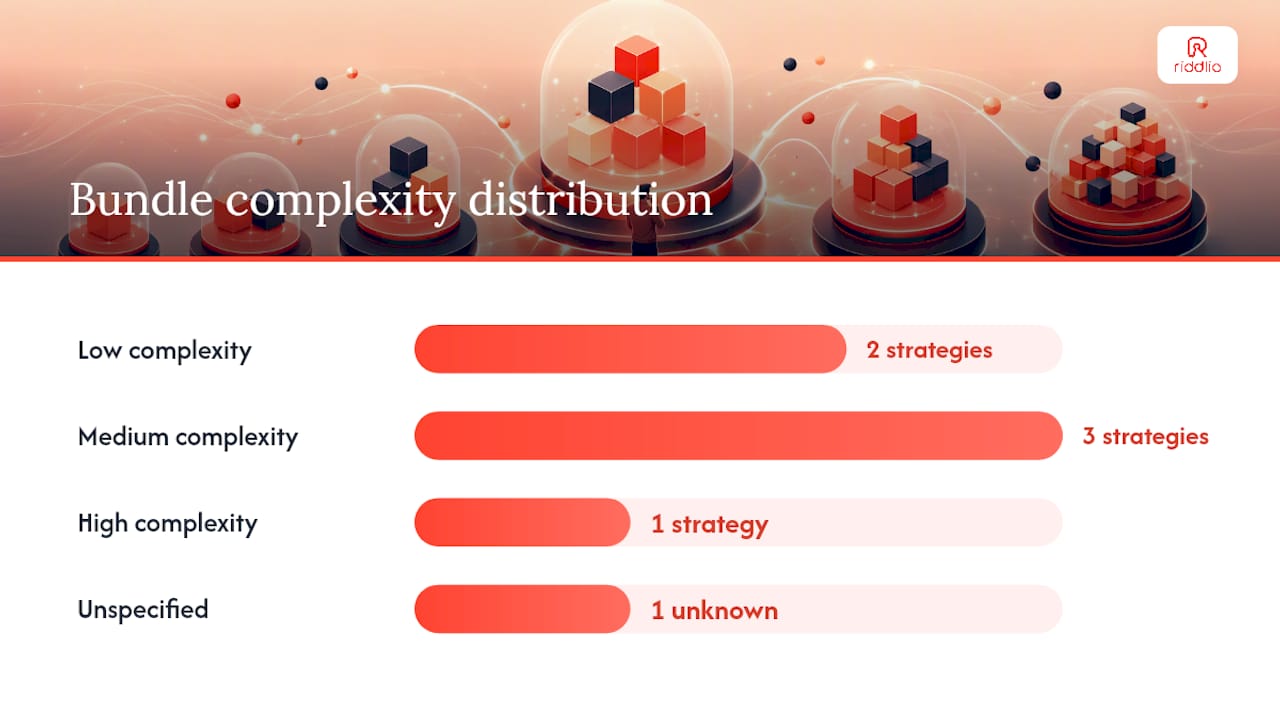
| Strategy | Best for | Pricing approach | Margin impact | Complexity | Expected outcome |
|---|---|---|---|---|---|
| Pure bundling | Curated kits, gift sets | Single fixed price, no a la carte | Moderate risk if mix is wrong | Low | Higher AOV, simplified SKU count |
| Mixed bundling | Most retail and ecommerce | Bundle price + standalone option | Controlled; buyers self-select | Medium | Conversion lift, attach rate growth |
| Leader bundling | Onboarding, upsell | Anchor product + discounted add-on | Low risk; add-on margin preserved | Low | Attach rate, incremental revenue |
| Captive pricing | Hardware/consumable, SaaS | Low base + recurring high-margin add-on | High long-term margin | Medium | Lifetime value, recurring revenue |
| Tiered bundles | SaaS, subscriptions | Feature or volume tiers at price steps | Strong if tiers are well-separated | High | Upgrade path, reduced churn |
| Post-purchase bundles | Ecommerce, experience venues | Offer triggered after initial purchase | Additive; no cannibalisation risk | Medium | AOV lift without front-end friction |
| Quantity bundles | Wholesale, consumables | Per-unit discount at volume thresholds | Watch for margin floor | Low | Larger basket size, repeat orders |
Stratridge’s pricing positioning research identifies four decisions that determine whether a bundle succeeds: why you are bundling, how much to discount, what to include, and how the bundle interacts with your other SKUs. Get any one of those wrong and the bundle either cannibalises your standalone sales or fails to convert.
Channel fit matters. Self-serve ecommerce suits mixed and quantity bundles because customers can compare options without help. Sales-led B2B works better with leader and tiered bundles where a rep can explain the value. Subscription and SaaS businesses almost always benefit from tiered packaging, where Stripe’s pricing and packaging guidance draws a sharp distinction: pricing sets the cost, while packaging groups entitlements into tiers and creates natural upgrade paths. Conflating the two leads to confused buyers and stalled upgrades.
How do you set the right bundle price?
Four methods cover most situations. Use whichever matches your data and margin profile.
1. Percentage off combined retail Add the individual retail prices, then apply a discount. Simple, transparent, and easy to communicate.
2. Fixed bundle price Set a price based on perceived value and margin targets, independent of the sum of parts. Works well when individual prices are not widely known.
3. Tiered volume pricing Price per unit drops at defined quantity thresholds. Common in wholesale and consumables.
4. Contribution-margin approach Price the bundle so that revenue minus variable costs (COGS) meets a minimum gross profit floor per order.
The contribution margin formula:
Your bundle is viable when that margin, as a percentage of the bundle price, stays above your category floor.
Worked example 1: physical retail
A gift shop sells three candles individually at $18, $22, and $15. Combined retail: $55.
- Combined COGS: $21 (blended across three SKUs)
- Bundle gross profit: $46 − $21 = $25
- Bundle gross margin: 54%
The bundle gives up $9 in gross profit but converts customers who would have bought only one candle, so AOV rises from $18 (single-item average) to $46. The maths works as long as the incremental volume offsets the margin given up per order.
Worked example 2: SaaS tier bundle
A project management tool offers three features: task tracking ($29/month), time reporting ($19/month), and client portal ($22/month). Combined: $70/month.
- Variable cost per user (hosting, support allocation): $8/month
- Bundle contribution margin: $59 − $8 = $51/month
- Standalone contribution margin (if all three bought separately): $70 − $8 = $62/month
The bundle gives up $11/month per customer but converts users who would have stayed on the $29 base plan. Net contribution per customer jumps from $21 to $51. That is the upgrade-path logic Stripe’s packaging guidance describes.
Recommended discount ranges by category:
| Category | Recommended discount range | Notes |
|---|---|---|
| High-margin ecommerce (60%+ GM) | 15–20% | 99minds research baseline for brands with ~60% gross margin |
| Mid-margin retail (30–60% GM) | 10–15% | Protect floor; test at 10% first |
| Low-margin categories (<30% GM) | 5–10% | Bundles here are about AOV, not discount depth |
| SaaS / digital products | 15–25% | Low variable cost allows more room |
| Experience / ticketing | 10–20% | Depends on fixed vs variable cost split |
Fudge puts the working range for most categories at 10–25% off the sum of individual prices.
Pro Tip: Set a gross profit floor before you publish any bundle. If the bundle price does not cover variable costs plus your minimum margin target, reprice or change the mix. Never let a bundle go live without running the contribution margin calculation first.
Bundle pricing examples you can adapt today
Retail: the value meal model
The primary goal is AOV and throughput speed. The operational note: the bundle must be easy to assemble and ring up in seconds, or it slows service and kills the margin gain. Takeaway: pair items with complementary demand and low assembly friction.
Subscription: the tier ladder
A streaming service offers three tiers: Basic (one screen), Standard (two screens + HD), and Premium (four screens + 4K + downloads). Each tier bundles features rather than discounting them. The goal is retention and upgrade revenue. Operationally, the packaging must make the value difference between tiers obvious at a glance. Takeaway: when features are your product, tiered packaging beats percentage discounts every time.
SaaS: the feature bundle
A CRM platform bundles its core contact management with email automation and reporting into a single “Growth” plan. Buyers who need all three features pay less than the sum of add-on prices, and the vendor reduces support complexity by standardising on fewer plan configurations. Takeaway: design bundles around buyer jobs-to-be-done, not around what is convenient to package together.
Experience venues: the group night out
An escape room venue bundles two game sessions, a merchandise item, and priority booking access for a group of six at a fixed price. The goal is AOV and advance booking commitment. Operationally, the venue needs to track voucher redemptions, manage room scheduling across two sessions, and handle the merchandise fulfilment at check-in. Takeaway: experience bundles convert best when the buyer can see the full night planned for them, not just a list of discounted items.

How to launch and A/B test a bundle offer
A bundle that is not measured is a guess. Here is a repeatable process.
Launch checklist:
- Define the goal: AOV lift, inventory clearance, conversion rate improvement, or attach rate growth. Pick one primary metric.
- Identify the target segment: new customers, repeat buyers, or a specific product category cohort.
- Choose the bundle type and pricing model from the taxonomy above.
- Write the marketing message around the buyer job, not the discount percentage.
- Map the fulfilment plan: how does the bundle get picked, packed, or scheduled?
- Assess inventory impact: do you have enough stock of every item in the bundle?
- Brief customer support on the bundle mechanics before launch.
A/B test setup:
- Split traffic 50/50 between the control (standalone product pages) and the bundle variant.
- Run the test until you reach statistical significance, typically a minimum of 100–200 conversions per variant depending on your baseline conversion rate.
- Measure profit per order as the primary metric, not revenue. A bundle that lifts revenue but compresses margin is not a win.
- Tag every bundle transaction with a dedicated discount code or SKU so you can isolate bundle revenue in your analytics.
- Use UTM parameters on any paid traffic driving to the bundle page.
KPIs to track and how to calculate them:
- AOV: Total revenue ÷ number of orders. Compare bundle cohort vs non-bundle cohort.
- Attach rate: Number of bundle orders ÷ total orders for the anchor product. Target 15–30% in most categories.
- Bundle gross margin: (Bundle price − bundle COGS) ÷ bundle price × 100.
- Conversion rate: Bundle page conversions ÷ bundle page sessions.
- Churn rate (subscriptions): Cancelled subscribers ÷ total subscribers at start of period. Compare bundle vs non-bundle cohorts.
Pro Tip: Tag bundle SKUs distinctly in your inventory system from day one. Mixing bundle and standalone sales data in the same SKU makes it impossible to calculate true attach rate or bundle margin accurately.
What are the risks of bundle pricing?
Bundles can hurt your business as easily as they help it. These are the failure modes worth knowing before you launch.
Cannibalisation happens when bundle buyers would have purchased all items at full price anyway. To detect it: compare the average number of items per order before and after the bundle launch. If multi-item orders were already common, your bundle is likely subsidising existing behaviour rather than changing it. Run a holdout group in your A/B test to measure the true incremental effect.
Margin erosion is the most common mistake. Operators set a bundle discount based on what feels competitive rather than what the contribution margin supports. The 10–25% range from Fudge.ai’s research is a starting point, not a floor. Always calculate the bundle margin before publishing.
Other pitfalls to watch:
- Bad product mix: Pairing a high-demand item with a product customers actively dislike does not clear inventory. It damages the perception of the high-demand item.
- Confusing packaging: Too many bundle options creates the same decision fatigue you were trying to solve. Three bundles maximum is a practical ceiling for most businesses.
- Channel conflict: If you sell through distributors or retail partners, a direct-to-consumer bundle at a steep discount can undercut their standalone pricing and damage the relationship.
- Training bargain behaviour: Repeated deep-discount bundles teach customers to wait for the deal. Rotate bundle offers and keep standalone pricing visible and credible.
Legal note: In the United States, the Department of Justice’s antitrust guidance on bundled discounts examines whether a bundle is priced below average variable cost or whether the discount forecloses equally efficient rivals from competing. For most small and mid-sized businesses, this is not a live risk. For dominant-market players or businesses in regulated industries, get legal advice before launching bundles that tie a market-leading product to a secondary one.
To protect standalone pricing in multi-channel environments: publish the bundle only on your own channels, set a minimum advertised price (MAP) policy for partners, and avoid bundles that make the standalone price look artificially inflated.
Applying bundle pricing to escape rooms: a practical walkthrough
Escape room venues are a natural fit for bundle pricing. The product is experiential, the costs are mostly fixed, and the average group is already spending on multiple items: tickets, merchandise, food, and sometimes a second room.
A concrete bundle example:
A venue charges $28 per person for a single room. A group of six pays $168. The venue creates a “Full Night Out” bundle: two room sessions for the group + a branded merchandise item per person + priority booking access, priced at $210 for the group.
The bundle’s goal is AOV and advance commitment. The group locks in two sessions upfront, reducing the risk of a half-empty second slot.
Operational checklist for experience venue bundles:
- Set up a dedicated bundle SKU or voucher code in your booking system so redemptions are tracked separately from standalone tickets.
- Map the scheduling logic: the two sessions need to be bookable in sequence without a gap that kills the group’s momentum.
- Use dynamic pricing to adjust the bundle price for peak vs off-peak slots, protecting margin on Friday and Saturday nights while filling Tuesday afternoons.
- Configure gift vouchers so the bundle can be purchased as a gift and redeemed online without staff intervention.
- Automate a post-booking SMS or email reminder that confirms both sessions and the merchandise pickup process, reducing no-show risk.
- Pull attach rate and AOV reports weekly to confirm the bundle is adding margin, not just revenue.
Riddlio’s platform handles each of these operationally: dynamic pricing by time slot and group size, voucher issuance and redemption, automated communications, and real-time analytics that separate bundle revenue from standalone ticket sales. When you present the bundle alongside single-ticket options, keep the pricing display simple: show the per-person bundle price next to the per-person single-room price, and let the saving speak for itself.
Pro Tip: Introduce the bundle as a second option on your booking page, not a replacement for the standard ticket. Customers who want simplicity will take the bundle; customers who want flexibility will book single sessions. You capture both without confusing either.
The part most guides get wrong about bundle pricing
Most bundle pricing advice focuses on the discount percentage and stops there. That is the wrong place to spend your analytical energy.
The discount is a consequence of the margin calculation, not a starting point. The right sequence is: identify the buyer job, select the bundle components that solve it, calculate the contribution margin at various price points, then set the discount at the level that feels meaningful to the buyer while staying above your floor.
The second thing most guides miss: bundle success is not measured at launch. It is measured at the 60-day mark, when you can see whether attach rates are holding, whether cannibalisation has shown up in your standalone sales data, and whether the customers who bought the bundle are returning at a higher rate than those who did not. A bundle that looks like a win in week one can quietly erode margin over a quarter if the product mix is wrong or the discount is too deep.
For experience businesses specifically, the operational complexity of a bundle is often underestimated. Scheduling two sessions, managing merchandise inventory, and handling voucher redemptions across a busy weekend requires systems that can track each component of the bundle separately. Without that visibility, you cannot calculate true bundle margin, and you cannot iterate.
Run the first test small. One bundle, one segment, 30 days. Measure profit per order, not revenue. Then decide.
Riddlio makes bundle operations practical for experience venues
Running a bundle at an escape room venue is straightforward in theory. In practice, the scheduling, voucher tracking, and payment reconciliation across multiple bundle components create real operational friction, especially on busy weekends.

Riddlio is built for exactly this. The platform combines online booking management, dynamic pricing by time slot and group size, gift voucher issuance and redemption, automated SMS and email reminders, and real-time analytics, all in one system. You can set up a bundle offer, track its attach rate and margin contribution separately from standalone tickets, and adjust pricing for peak periods without touching your base rates. There are no per-booking fees, so the economics of a discounted bundle do not get quietly eaten by transaction costs. Start a free trial at Riddlio and have your first bundle live within a week.
Sources
- Pricing and packaging strategy — Stripe resources
- How and when to use bundle pricing — Simon-Kucher
- Pricing positioning for bundles and packaging — Stratridge
- Fudge
- Product bundling examples and pricing — 99minds
- Antitrust analysis of bundled discounts — US Department of Justice