Which FareHarbor alternatives suit Australian escape room venues?
The best FareHarbor alternatives for Australian escape room operators are platforms that offer transparent flat-rate pricing, rental-native workflows, and native POS integration rather than the tour-focused, commission-heavy model FareHarbor was built around. The core problem with FareHarbor for escape room venues is structural: it was designed for fixed-time tours with per-headcount pricing, not for the complex room turnarounds, equipment scheduling, and walk-up bookings that define escape room operations.
The main categories of alternatives worth evaluating in 2026:
- Subscription-based, escape-room-native platforms like Riddlio, which combine flat monthly fees with purpose-built features including real-time slot management, automated SMS reminders, digital waivers, and native POS. No per-booking commission means your software cost stays predictable as revenue grows.
- Distribution-first platforms built around OTA channel management, suited to operators whose primary growth channel is resellers and third-party booking agents. These typically charge a percentage per online booking rather than a flat monthly fee.
- Walk-up and POS-focused platforms that prioritise in-person sales, native card readers, and AI-driven revenue tools. These suit venues with high foot traffic but often carry variable booking fees that are not publicly listed.
- Rental-native platforms designed for date-range bookings and equipment management. These handle multi-day rentals well but can struggle with the time-slot-based scheduling that escape rooms require.
FareHarbor’s connection to Booking Holdings’ affiliate network gives it genuine OTA reach, but that distribution advantage comes with fees that are typically passed directly to customers at checkout. For Australian escape room venues where direct bookings dominate and customer experience at checkout matters, that trade-off rarely makes sense.
Table of Contents
- What criteria matter most when choosing escape room booking software?
- How do leading platforms compare on features and pricing?
- What Australian escape room operators say about switching platforms
- Riddlio is built for exactly this kind of venue
- Key takeaways
What criteria matter most when choosing escape room booking software?
Picking the wrong platform costs more than the monthly fee. A mismatch between your workflow and your software creates friction at every point: double bookings, clunky check-ins, and payment reconciliation headaches that eat into your team’s time.
The criteria that separate a good fit from a poor one for escape room operators:
- Rental-native workflow support. Escape rooms need time-slot scheduling with buffer periods for room resets, not the per-headcount tour model. Rental-native workflows handle complex turnarounds and equipment management far better than platforms built around fixed-duration tours.
- Native POS hardware integration. Walk-up bookings are a real revenue stream for most venues. A platform that handles onsite POS natively rather than through a bolted-on third-party terminal keeps check-in fast and payment processing clean.
- Booking fee flexibility. The choice to absorb a per-booking fee or pass it to the customer is yours to make, not the platform’s. Platforms that force a customer-facing “convenience fee” at checkout create friction you cannot remove.
- Pricing model transparency. Subscription-based pricing gives you predictable monthly costs. Commission-based models grow in dollar terms as your revenue grows, which is why operators increasingly prefer flat fees for financial planning.
- Customer data ownership. Some platforms lock your customer records inside their ecosystem, making migration difficult and limiting your ability to run your own CRM or email marketing. Full data portability matters when you want to control your marketing tools.
- Scalability and integrations. As you add rooms or locations, your software should handle the added complexity without requiring a plan upgrade just to access basic features. CRM integrations, marketing tool connections, and open APIs are worth checking before you sign.
Pro Tip: Schedule any platform migration during your venue’s off-peak period, typically mid-week in winter months for most Australian escape rooms. Switching systems during a busy weekend risks booking disruptions and puts unnecessary pressure on staff learning a new interface.
How do leading platforms compare on features and pricing?
The comparison below covers the dimensions that matter most to escape room operators: feature fit, POS capability, fee flexibility, pricing model, real-time inventory management, and whether the workflow is built for rental-style scheduling or tour-style scheduling.
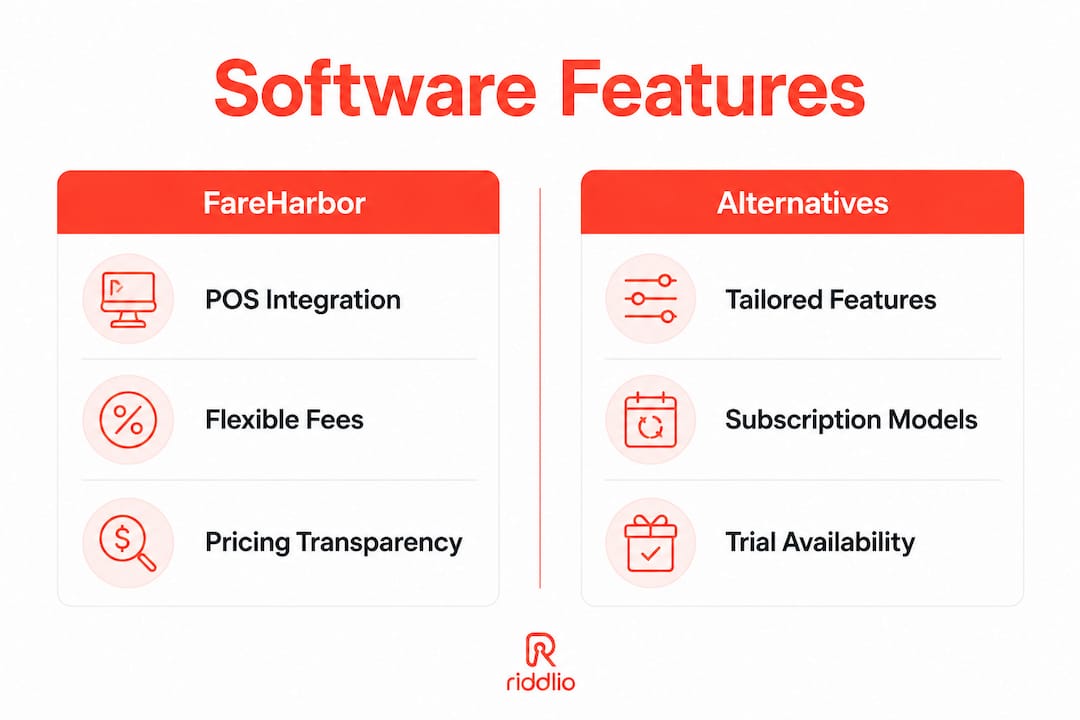
| Platform type | Feature set relevance | POS integration | Booking fee flexibility | Pricing model | Real-time inventory | Rental-native workflow |
|---|---|---|---|---|---|---|
| Escape-room-native (e.g. Riddlio) | Built specifically for escape rooms: waivers, SMS reminders, dynamic pricing, staff scheduling | Native POS with card readers and kiosk mode | No per-booking commission; flat monthly fee only | Subscription, tiered monthly plans | Yes, full real-time slot management | Yes, purpose-built for room turnarounds |
| Distribution-first platforms | Strong OTA channel management; tour-focused feature set | Via integrations, not native | Operator chooses to absorb or pass a per-booking fee | Subscription plus per-booking percentage from $49/month | Yes | Limited; tour-shaped workflow |
| Walk-up and POS-focused platforms | AI revenue tools, abandoned-booking recovery, upsells | Native EMV card readers and mobile POS | Fee typically passed to customer; variable booking fees reported, not publicly listed | Quote-based, not published | Yes | Limited |
| FareHarbor | Mature tour reservation engine; OTA distribution via Booking Holdings network | FareHarbor Dock multi-device POS | Fee shown as customer-facing convenience fee; operators report fees are typically passed directly to customers at checkout, though the exact percentage is not officially published | Quote-based, not published | Yes | Limited; tour-shaped |
| Rental-native platforms | Strong for date-range rentals and equipment management | Limited or via integrations | Flat monthly fee, no commission | Subscription from a flat monthly fee | Yes | Yes, but weak on time-slot bookings |
A few things stand out in this comparison. First, the only platform category with publicly listed, transparent pricing is the subscription-based group. FareHarbor and walk-up-focused platforms both use quote-based or onboarding-based pricing, which means you cannot compare costs without a sales call. Second, rental-native platforms handle equipment and date-range bookings well but tend to struggle with the precise time-slot management escape rooms depend on. Third, the escape-room-native category, where Riddlio sits, is the only one purpose-built for the specific scheduling, waiver, and communications workflow an escape room actually runs.
Most platforms offer either a free trial or a demo. Riddlio offers a free trial so you can test the full workflow before committing. Distribution-first platforms typically offer a free trial period as well, while walk-up-focused and quote-based platforms generally provide demos rather than self-serve trials.
What Australian escape room operators say about switching platforms
Across the Australian escape room industry, the pattern operators describe when switching away from FareHarbor or generic tour booking platforms is consistent. The trigger is rarely a single feature gap. It tends to be the accumulation of small frictions: a per-booking fee that grows as the venue gets busier, a checkout flow that shows customers a separate “convenience fee” they did not expect, and a support model that routes every change through an account representative rather than letting the operator make adjustments directly.

Venues that move to subscription-based platforms built for entertainment and activity operators consistently report two immediate improvements: cost predictability and faster check-in. When your software fee is a flat monthly amount rather than a percentage of revenue, budgeting becomes straightforward. When your POS is native rather than integrated through a third-party terminal, walk-up check-ins take seconds rather than minutes.
The operators who find the transition hardest are those who relied heavily on OTA distribution through their previous platform’s affiliate network. If a meaningful share of your bookings come through Viator, GetYourGuide, or similar channels, you need to confirm that any alternative platform either maintains those connections or gives you the tools to manage them independently. For most Australian escape rooms, where direct bookings via a venue website dominate, this is less of a concern than it is for tour operators.
Riddlio is built for exactly this kind of venue
Escape room operators evaluating FareHarbor alternatives are not looking for a generic booking tool with a few extra features. They need software that understands how an escape room actually runs: back-to-back sessions with reset buffers, waivers collected before entry, dynamic pricing across peak and off-peak slots, and a front desk that handles walk-ups without slowing down the queue.

Riddlio is built specifically for this. The platform covers online booking management, payment processing via Stripe, Square, and PayPal, automated email and SMS reminders that cut no-shows, digital waivers, staff scheduling, gift voucher sales, a self check-in kiosk, and AI-assisted analytics, all in one system. Pricing is a flat monthly subscription with no per-booking commission, so your software cost does not climb every time you have a strong weekend.
For Australian venues, Riddlio’s native POS integration handles walk-up bookings and in-person payments without a separate terminal or a third-party workaround. The dynamic pricing tools let you set different rates for peak sessions, group bookings, and off-peak slots without manual adjustments. You own your customer data outright, which means your CRM and marketing tools connect on your terms.
See how Riddlio fits your venue at riddlio.com/escape-room-booking-system.
Key takeaways
Escape room operators choosing a FareHarbor alternative need a platform built for time-slot scheduling, flat-rate pricing, and native POS, not a repurposed tour booking engine.
| Point | Details |
|---|---|
| Pricing transparency matters | FareHarbor and walk-up-focused platforms use quote-based pricing; subscription platforms publish their rates upfront. |
| Rental-native workflows fit escape rooms | Platforms built for room turnarounds and slot scheduling outperform tour-focused systems for escape room operations. |
| Fee pass-through affects customer experience | Platforms that force a customer-facing convenience fee at checkout create friction the operator cannot remove. |
| Migrate during off-peak periods | Switching booking systems mid-peak season risks disruption; plan transitions for low-traffic periods. |
| Riddlio is purpose-built for escape rooms | Flat monthly fee, native POS, automated reminders, and AI analytics designed specifically for escape room venues in Australia. |