Start recovery immediately: detect the failure, classify the decline code, and launch a smart retry plus a single dunning message within 24 hours. That three-step sequence is where most venues recover the bulk of what they lose.
Rezoki estimates that soft declines account for a majority of payment failures, and recovery probability drops sharply after the first 72 hours. That window is your leverage point.
Your 3-step action plan:
- Step 1: Set up a webhook to detect failures in real time and log the decline code immediately.
- Step 2: Classify the code as soft (retry) or hard (route to customer update). Stripe’s smart-retries documentation lists the hard-decline codes that should never be retried automatically.
- Step 3: Trigger a smart retry for soft declines and send one friendly dunning message within 24 hours.
Pro Tip: Prioritise retries in the first 72 hours. After day three, recovery rates fall sharply. Never retry hard-decline codes such as stolen_card or incorrect_number — you will waste attempts and risk fraud flags.
Key takeaways
Effective payment failure recovery combines smart retries on soft declines with a prompt dunning sequence started within 24 hours, and the two tactics together consistently outperform either one alone.
| Point | Details |
|---|---|
| Classify before retrying | Soft declines are retryable; hard declines route to a customer update page immediately. |
| 72-hour golden window | Recovery probability drops sharply after day three, so start retries and dunning within 24 hours. |
| Tokenised update links | One-click payment update pages with pre-filled booking context outperform login-first flows. |
| Track five KPIs | Recovery rate, revenue recovered, retries per success, decline-category split, and time-to-recovery. |
| Riddlio for venues | Riddlio integrates Stripe, Square, and PayPal with automated SMS and email dunning for escape room operators. |
Table of Contents
- Why failed payments cost venues more than one booking
- How to classify decline codes before choosing a recovery path
- What recovery strategies work, and when to use each
- Designing a dunning sequence that actually converts
- Technical tactics: smart retries, cross-processor routing, and card updaters
- How to reduce friction on your payment update page
- Metrics and dashboards to measure recovery performance
- Implementation checklist for the first 30 days
- Pitfalls and compliance issues that can break your recovery
- Handling payment failures during subscription pauses, upgrades, or downgrades
- Integration challenges and best practices for payment gateway APIs
- What venue operators get wrong about payment recovery
- Riddlio handles payment recovery so your venue can focus on bookings
- Sources
Why failed payments cost venues more than one booking
A failed payment is not just a missed transaction. For venues running recurring memberships or advance bookings, it is the first step toward passive churn: the customer never cancels, they just quietly disappear because the payment never went through.

Consider a venue with 20 failed bookings per month at an average value of $85. That is $1,700 at risk every month. At scale, even a modest lift in recovery rate compounds quickly.
Rezoki’s analysis supports this framing: intelligent retries and multi-channel outreach, started early, are the highest-return intervention for subscription and recurring-revenue businesses.
How to classify decline codes before choosing a recovery path
Classify the error first. Every failed payment carries a decline code, and that code tells you whether to retry, ask the customer to update their card, or stop entirely.
Soft declines are temporary. The card is valid but the transaction failed for a recoverable reason:
- Insufficient funds at the time of charge
- Issuer rate-limiting or temporary hold
- Network timeout or processor outage
- Generic “do not honour” codes that often clear on retry
Hard declines are permanent. Retrying them wastes attempts and can trigger fraud reviews:
stolen_cardorlost_cardinvalid_numberorincorrect_number- Closed or frozen account
authentication_requiredwhere no 3DS flow is available
| Decline category | Example codes | Recommended action |
|---|---|---|
| Soft decline | insufficient_funds, do_not_honor |
Schedule smart retry within 24–72 hours |
| Network/timeout | processing_error, card_velocity_exceeded |
Retry after short delay; check processor status |
| Hard decline | stolen_card, invalid_number |
Route to customer update page; no auto-retry |
| Auth required | authentication_required |
Trigger 3DS flow or request new payment method |
What recovery strategies work, and when to use each
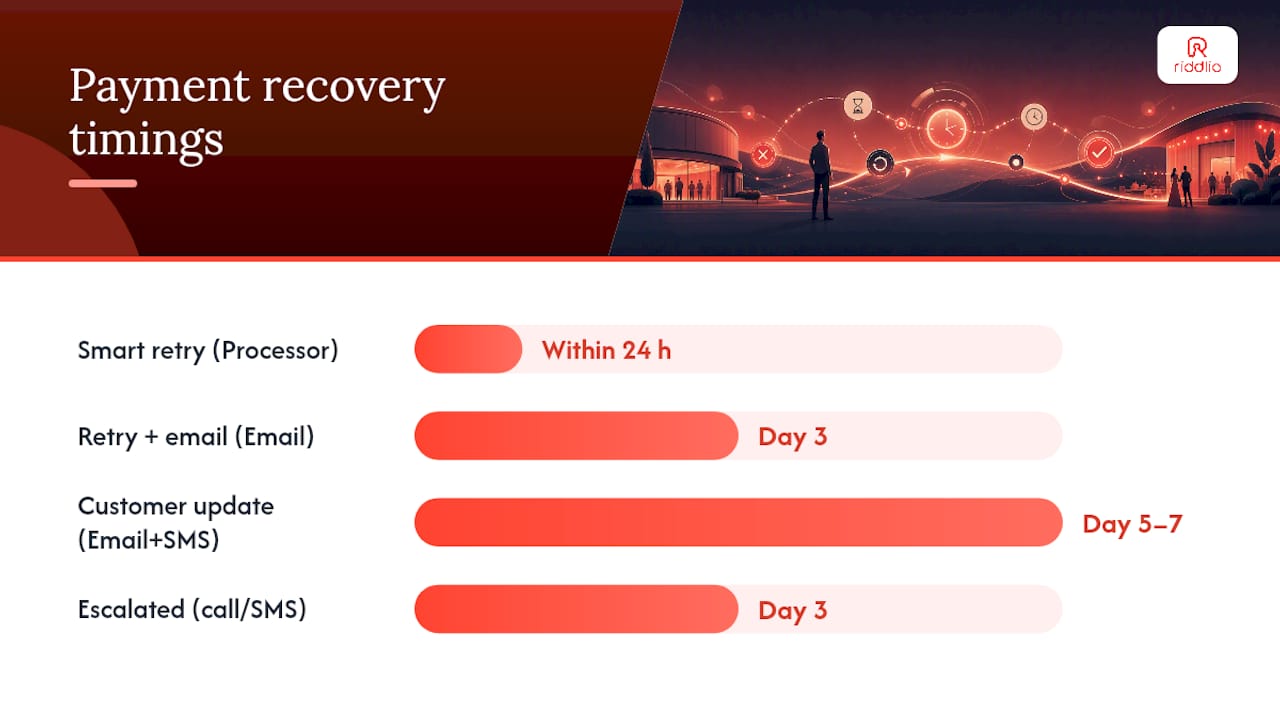
The most effective approach runs as a funnel, not a single tactic. Smart retries handle the bulk of soft declines without any customer friction. When retries fail, you escalate.
The recommended sequence: smart retries → backup payment method attempt → customer update prompt (email) → escalated outreach (SMS or phone) → cancellation only after a defined window has closed.
Stripe’s failed payment recovery guidance frames this as a revenue operation, not just a technical retry loop. Combining retries with prompt dunning consistently outperforms either tactic alone.
| Attempt | Tactic | Channel | Timing |
|---|---|---|---|
| 1 | Smart retry | Processor | Within 24 hours |
| 2 | Retry + email notice | Day 3 | |
| 3 | Customer update prompt | Email + SMS | Day 5–7 |
| Final | Escalated outreach | SMS or phone | Day 3 |
Designing a dunning sequence that actually converts
An escalating three-to-five touch sequence, starting within 24 hours, outperforms a single notification every time. The tone shifts from friendly to urgent as the window closes.
Sample cadence:
| Day | Channel | Subject line (A/B test) | CTA |
|---|---|---|---|
| 1 | “Your booking payment needs attention” / “Quick update needed for your booking” | Update payment | |
| 3 | “We couldn’t process your payment” | Update now | |
| 7 | Email + SMS | “Your booking is at risk” | One-click update |
| 8 | SMS | “Final notice: booking cancellation pending” | Call to action |
Recharge’s recovery platform supports in-portal payment updates, preset templates that escalate urgency, and A/B testing of message content. Their setup guide walks through notification customisation and explains how activating a new strategy takes over existing dunning cycles.
A/B test prompt: Test subject line urgency (neutral vs. risk-framing) on Day 1. KPI: payment update rate within 48 hours.
Pro Tip: Keep the Day 1 message warm and assumption-free. “Your card may have expired” lands better than “Your payment failed.” Customers respond to help, not accusation.
Technical tactics: smart retries, cross-processor routing, and card updaters
Smart retries and cross-processor orchestration lift recovery rates when configured correctly. Static retry schedules, by contrast, often hit the customer at the wrong moment and burn through network-permitted attempts.
Stripe’s smart retry engine uses time-dependent signals to choose retry timing and supports up to eight retries within a two-week window by default. It also flags hard-decline codes as non-retryable, so attempts stop automatically rather than cycling pointlessly.
For venues using multiple processors, Stripe Orchestration lets you configure a secondary processor to attempt the charge when the primary fails. Cross-processor retries can recover payments during outages or network-specific declines, though 3DS requirements and feature gaps can limit when this path is available.
ChurnDefense’s retry playbook notes that Visa and Mastercard cap retry attempts within a 30-day rolling window. Exceeding those limits risks fines and account review. Network tokenisation and account-updater services address a different problem: stale card data. When a card is reissued, an account updater corrects the stored PAN before the next charge attempt, preventing failures that have nothing to do with funds.
Implementation notes for your engineering team:
- Detect failures via webhook (
payment_intent.payment_failedor equivalent). - Log
decline_codeandattempt_counton every event. - Branch logic: soft decline → schedule retry; hard decline → trigger customer update flow.
- Fallback order: primary card → backup card → ACH → manual update request.
- Enable account updater services through your processor (Stripe, Square, or PayPal all support variants of this).
Pro Tip: Never retry more than the network allows. Build a counter against the rolling window, not just the individual charge.
How to reduce friction on your payment update page
One-click or tokenised links to a payment update page outperform login-first flows. Every extra step between the customer and the update form costs you completions.
UX checklist for your update page:
- Send a tokenised link directly to the update form, no login required
- Pre-fill the booking context (date, room, amount) so the customer knows exactly what they are paying for
- Single CTA: one button, one action
- Mobile-first layout — most customers open dunning emails on a phone
- Show the amount and next charge date clearly
- Allow card update without creating an account if your security model permits
Recharge’s in-portal update flow demonstrates this well: customers can update payment details directly from the notification link without navigating a full account dashboard.
Pro Tip: Add a one-line urgency note near the CTA: “Update by [date] to keep your booking.” Specific deadlines convert better than open-ended prompts.
Metrics and dashboards to measure recovery performance
Track five numbers. Everything else is noise until these are healthy.
- Recovery rate: recovered orders ÷ total orders with a failure (target: above 50% for soft declines)
- Revenue recovered: sum of transaction values successfully retried or updated
- Retries per success: total retry attempts ÷ recovered orders (lower is better)
- Decline-category split: percentage of failures by code category (soft vs. hard vs. auth)
- Time-to-recovery: average hours from first failure to successful charge
| Dashboard widget | What it shows | Update frequency |
|---|---|---|
| Recovery rate | % of failures resolved | Daily |
| Revenue recovered | $ value recovered this period | Weekly |
| Top decline codes | Most common failure reasons | Weekly |
| Retries per success | Efficiency of retry logic | Weekly |
| A/B test results | Message variant performance | Per campaign |
Implementation checklist for the first 30 days
Start with the highest-impact, lowest-effort items. Get the webhook and decline classification working before touching cross-processor routing.
- Set up failure webhooks — Owner: engineer. Time: 1–2 days.
- Classify decline codes — Owner: engineer/payments. Time: 1 day.
- Enable smart retries — Owner: payments. Time: hours (processor config).
- Set dunning cadence (3–5 touches) — Owner: ops/marketing. Time: 1–2 days.
- Build tokenised payment update page — Owner: engineer. Time: 2–3 days.
- Enable account updater service — Owner: payments. Time: 1 day.
- Set up recovery dashboard — Owner: ops. Time: 1 day.
| Task | Owner | Estimated time |
|---|---|---|
| Webhook setup | Engineer | 1–2 days |
| Decline code classification | Engineer/payments | 1 day |
| Smart retries config | Payments | Hours |
| Dunning sequence | Ops/marketing | 1–2 days |
| Payment update page | Engineer | 2–3 days |
| Account updater | Payments | 1 day |
For venues tracking payment operations alongside booking back-office tools, TravelEngine’s payment tracking guide covers reconciliation workflows that complement this setup.
Pitfalls and compliance issues that can break your recovery
Respect network retry limits and PCI scope. Ignoring either risks fines, processor penalties, and account review.
Common pitfalls:
- Retrying hard-decline codes (wastes attempts, triggers fraud flags)
- Exceeding Visa/Mastercard retry caps within the 30-day rolling window
- Storing raw card data outside PCI scope instead of using processor tokens
- Forcing account login before the payment update page (kills completion rates)
- Ignoring SMS/email opt-outs in dunning sequences (CAN-SPAM and TCPA apply in the US)
- Failing to log attempt counts, making it impossible to audit retry behaviour
Compliance checklist: Confirm your payment flows are within PCI scope by using processor-hosted fields or tokens — never handle raw PANs in your own code. Get explicit consent before sending dunning SMS messages. Include a one-line unsubscribe option in every dunning email. Set a defined cancellation window and honour it. Review your processor’s retry policy documentation annually, as network rules change.
ChurnDefense recommends branching retry logic by decline code and using tokenisation to prevent stale-card failures before they occur.
Handling payment failures during subscription pauses, upgrades, or downgrades
A payment failure mid-cycle complicates things when the customer is also changing their plan. The failure and the plan change can conflict in your billing system if you do not handle the sequencing explicitly.
The safest approach: resolve the outstanding failure before processing any plan change. If a customer requests a pause while a charge is in a retry cycle, pause the retry cycle at the same time. If they are upgrading, collect the new payment method as part of the upgrade flow and use it to clear the outstanding balance first.
For downgrades, the risk is different. A customer downgrading during a failed payment window may be signalling intent to leave. Treat the failure and the downgrade request as a combined retention signal and route both to a human review or a targeted retention offer rather than processing them separately.
Integration challenges and best practices for payment gateway APIs
The most common integration failure is treating the payment gateway as a black box. Webhooks arrive out of order, retry events duplicate, and decline codes vary between processors. Build defensively from the start.
Use idempotency keys on every retry attempt so duplicate webhook events do not create duplicate charges. Log every event with its payment_intent_id, attempt_count, and decline_code before taking any action. Test your webhook handler against all failure scenarios in the processor’s sandbox, not just the happy path.
When integrating multiple processors (Stripe as primary, Square or PayPal as fallback), normalise decline codes to your own internal taxonomy before branching logic. Each processor uses slightly different code strings for the same underlying condition. Riddlio’s payments integration with Stripe, Square, and PayPal is built to handle this normalisation at the platform level, reducing the engineering burden on individual venues.
Pro Tip: Set up a dead-letter queue for webhook events that fail processing. Silent failures in your webhook handler are the hardest bugs to diagnose and the most expensive in terms of missed recoveries.
What venue operators get wrong about payment recovery
The conventional wisdom says “set up retries and you’re done.” That framing misses the point. Retries handle the easy cases. The real revenue is in the middle tier: soft declines where the customer has funds but the timing was wrong, or where the card was reissued and the stored token is stale.
Most venues under-invest in the customer-facing side of recovery. A tokenised update link sent within 24 hours, with the booking context pre-filled and a clear deadline, will outperform three rounds of automated retries for any failure that requires customer action. The retry logic and the dunning sequence are not competing approaches. They run in parallel, and the combination is what produces a recovery rate worth reporting.
The other underrated lever is the account updater service. Enabling it through your processor costs almost nothing and silently corrects a meaningful share of stale-card failures before they ever appear in your failure queue. Most small venues skip it because it is not visible in the dashboard. That is exactly why it is worth enabling first.
Riddlio handles payment recovery so your venue can focus on bookings
Escape room venues running payments through multiple processors, sending dunning emails manually, and chasing failed bookings one by one are leaving recoverable revenue on the table every month.
Riddlio bundles booking management, payment processing, and automated communications into one platform built specifically for escape room operators. Venues connect Stripe, Square, or PayPal directly, and Riddlio handles the payment update flows, SMS reminders, and booking notifications that form the backbone of a working recovery sequence.

- Payments integration: connect Stripe, Square, or PayPal and manage all transactions from one dashboard
- SMS and email reminders: automated SMS reminders fire on your dunning cadence without manual intervention
- Analytics: track recovery rate, revenue recovered, and booking performance in real time
- No-show reduction: automated pre-booking reminders cut no-shows alongside failed payment recovery
If you are ready to stop managing payment failures manually, see how Riddlio’s payment features work and start a trial.
Sources
- smart-retries
- Churn prevention through failed payment recovery | Recharge
- How to create a Failed Payment Recovery strategy – Recharge
- Failed Payment Recovery: The Complete Guide for SaaS (2026) | Rezoki
- Failed Payment Recovery: A Retry Playbook for SaaS | ChurnDefense